Physical climate risks for energy assets: from a European warning signal to reviewing your park
Historical period: Climate risk assessment 2024 · Grid review 2025
Topic date:
Published:
The 2024 European climate risk assessment shows risks to energy supply. What matters for your park are exposure, technical vulnerability and the consequences for operations.
A wind or solar park can have good conditions on annual average and still be noticeably affected by individual weather events. For you as an operator or asset manager, long-term yield is therefore not the only thing that counts. Possible damage, interruptions, maintenance effort and access to the site are just as important. Physical climate risks describe these consequences of climate impacts. They differ from transition risks, which arise, for example, from new market rules, technologies or changes in energy policy.
This article explicitly puts historical European publications into context. The starting point is the first European Climate Risk Assessment by the European Environment Agency, published on 10 March 2024. We also consider review 01/2025 on the electricity grid by the European Court of Auditors. The article itself is published on 5 October 2026. We do not use the findings of that time as a complete picture of 2026, and we do not derive a blanket probability of damage for your assets from them.
What the European climate risk assessment says
The European Environment Agency identifies 36 major climate risks for Europe. They concern, among other things, ecosystems, food, health, infrastructure, and the economy and finance. The summary of the report states that more action is already needed for 21 of these 36 risks. Eight are classified as particularly urgent. This classification is an assessment of European priorities for action. It is neither an asset rating nor a statement that every site is equally affected.
For the energy sector, disruptions from heat and drought and from flooding are especially relevant. The agency also stresses the interplay of climatic and non-climatic factors. Age, condition, maintenance, redundancy and protective measures influence how severely an event hits. The same flood hazard can therefore have different consequences for two assets. A site on a hazard map is the start of the investigation, not its economic end result.
Distinguish hazard, exposure and vulnerability
A hazard describes a possible event, such as extreme heat or flooding. Exposure means that an asset can be subject to this event. Vulnerability describes how sensitively the specific asset responds to it. Only together do these aspects make up a meaningful risk assessment. If you only look at the colour on a map, the link to your technology is missing. If you only look at your technology, the link to the site is missing. Both perspectives have to be connected.
Ask simple questions for each important component: which load is relevant? Which operating specifications apply? What do you know from past events? Which protective measures are in place? What would an outage mean? These questions should not cover only the generating asset. A shared transformer, an access road or a communication link can also be decisive. Where information is missing, the register should contain an open review task rather than an apparently final assessment.
Heat affects more than solar yield
For solar parks, heat is often first considered as a temperature-related loss of yield. That is an important starting point, but not the only one. For the operational review, you should also consider inverters, transformers, cables and cooling. Which limits actually apply depends on the respective design and the manufacturers' specifications. Avoid a blanket percentage deduction for all assets. It can hide differences in construction, installation location, ventilation and operational management.
In box 2 of its grid review 01/2025, the European Court of Auditors cites a concrete historical example. In July 2023, temperatures in Sicily exceeded 41 degrees Celsius. The heat damaged underground cables; at the same time, numerous wildfires broke out under dry conditions. Thousands of connections were interrupted for more than 24 hours. This example shows a possible chain of effects. It does not provide a general failure rate for German cables, solar parks or substations.
Flooding: the grid connection is part of the asset
When you review flood risks, you should consider the shared electrical infrastructure as well as the park area. An affected connection can limit the production of several assets at once. Even if individual modules or turbines remain undamaged, operability can depend on another component. The European climate risk report classifies such dependencies as risk cascades. This means that a disruption in one system can affect further systems.
The European Environment Agency explicitly describes such cascades for critical energy, water and transport infrastructure. For your review, this is a reason to write down dependencies. Which assets share the same connection? Where are the main switching and control facilities? Is the site accessible during an event? A regional flood map does not answer all of these questions. It helps you prioritise investigations; the technical and on-site review remains necessary.
Wildfire and the limits of a site metric
For wildfire, a distinction must be made between a hazard indication and a full fire-protection assessment. A climate indicator can show that a site is comparatively more exposed. That does not yet tell you what damage would occur at the specific asset or how an event could be handled. For operational organisation, local conditions, existing protection concepts and coordination with the responsible authorities are also relevant. A general risk score must not replace this information.
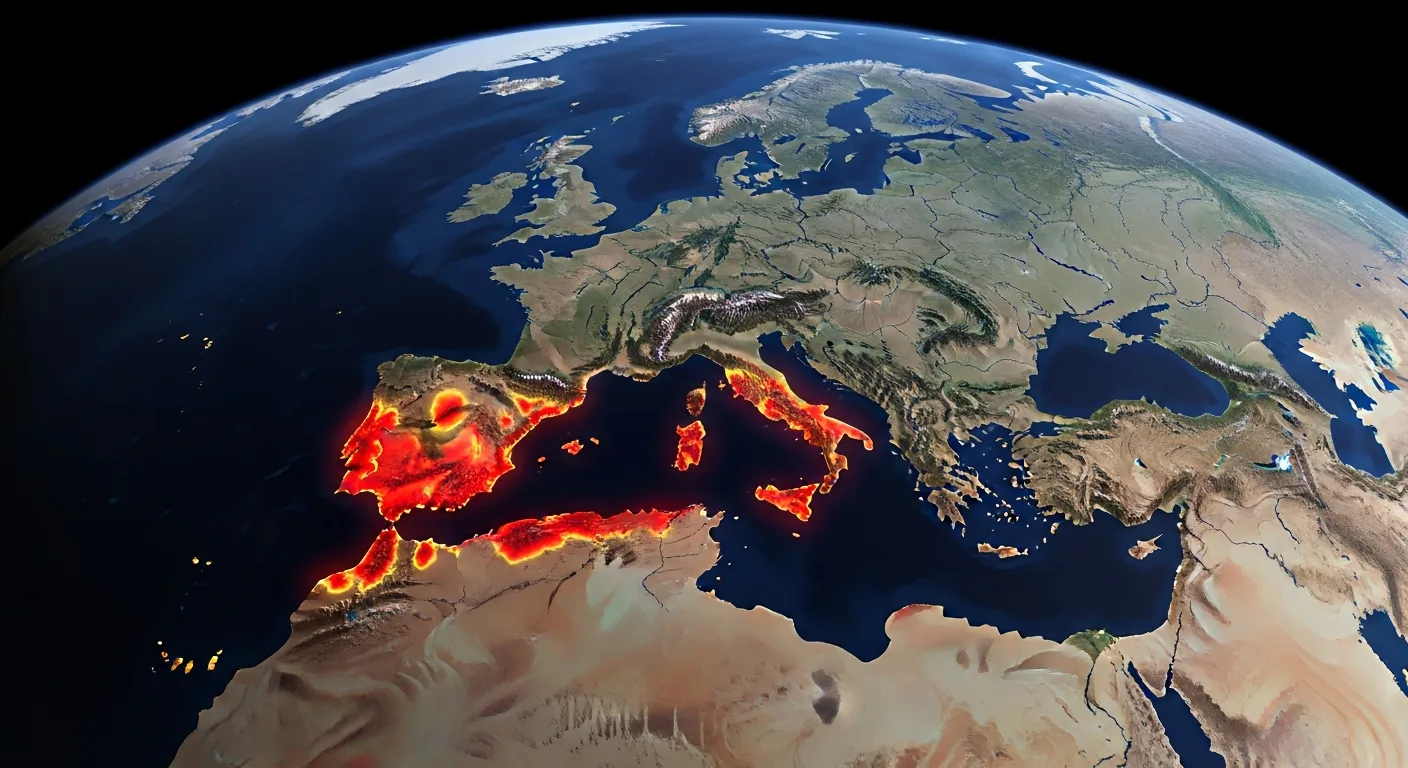
The EEA highlights southern Europe as a hotspot for several risks from heat, drought and fire. That does not mean other regions are risk-free. Nor can you transfer a European hotspot to every park without a local review. Use the European assessment as orientation at portfolio level. For the individual asset, you should then document which data are available, which hazards are actually relevant and which further investigations remain necessary.
Wind parks: review weather-related loads and condition together
For wind parks, you should distinguish between normal yield variability and loads that affect operations or condition. Icing, lightning, hail, extreme wind and component fatigue raise different questions. A deviation in yield does not prove component damage. Conversely, an unremarkable annual output cannot rule out a technical anomaly. So use operating logs, maintenance information and technical inspections in addition to weather and climate data. A coherent explanation should name the respective uncertainties.
A possible retrofit is not automatic either. Blade de-icing or better lightning protection can be listed as an option to review in the measures register. Whether the investment makes sense depends on your price, the costs and the remaining operating period. The same applies to condition-based maintenance and rotor renewal. We calculate this economic trade-off together with you. A European climate report can justify the need for investigation, but it cannot confirm the profitability of a specific measure.
What EnviroTrust shows at asset level
EnviroTrust shows physical climate risks per asset: flood zone, wildfire, hottest day of the year and, in Germany, snow load. In addition, risks and measures are linked in the register. The portfolio hierarchy of plant, asset and component makes it possible to classify a turbine, a PV component or a shared grid connection accordingly. This gives you a structured basis for further review. It is not a complete technical assessment of every possible hazard.
Battery storage and grid connections are portfolio asset types. They are assessed through the risk and measures register, for example with thermal derating, cycle ageing, transformer derating and wildfire. There is no separate physical yield model for these types. Weather and climate projections cover more than 30 European countries. Regional flood zones and snow load, as well as the register and grid data, are limited to Germany. These differences should remain visible in every portfolio analysis.
Historical data are not a fixed picture of the future
For the yield side, EnviroTrust uses hourly weather data for the last 20 complete years via Open-Meteo. Up to 2016 this is the ERA5 reanalysis; from 2017 it is a finer-resolution weather model. The climate projections come from EURO-CORDEX with a grid spacing of about 25 kilometres. RCP 2.6, 4.5 and 8.5 stand for different emission pathways. They support the comparison of possible future developments. They do not predict a specific storm or flood.
If you want to keep operating an asset for many years, the review should consider different time horizons. Different information matters for imminent maintenance than for replacing a transformer. The EEA stresses the long lead and decision times of infrastructure measures. That does not create an obligation to implement every conceivable measure immediately. It does create the need to include future conditions in decisions whose effects will last a long time.
Value measures without counting benefits twice
A good economic assessment distinguishes between avoided damage, avoided interruptions and additional generation. These items must not simply be added up. If an assumed downtime is already included in a yield calculation, the same benefit must not appear a second time as an additional revenue item. Record which baseline a measure refers to. Remaining risks after implementation should also be visible, not just the hoped-for improvement.
EnviroTrust values linked measures at your EEG tariff, your power purchase agreement or day-ahead prices via ENTSO-E. Investment horizon and discount rate are added, that is, the assumption for valuing future payments today. The results are planning values. They are not quotes and not guaranteed savings. A positive result under one assumption is not general proof of profitability. We check with you whether the assessment holds at other prices, costs and time periods.
Turning a map into a work list
For a larger portfolio, a traceable process is advisable. First record assets and shared components. Then mark relevant hazards and what is known about the technology. Assign a responsible person to open points. Only then should you compare measures economically. A priority list can, for example, distinguish between an immediate technical review, additional data collection and a longer-term planning question. That is more useful than a single ranking without justification.
Keep operational and organisational differences in mind. Two assets of the same series can have different maintenance histories, connection dependencies or remaining lifetimes. A fund manager also needs a consistent presentation across several parks. An operations manager, by contrast, needs concrete documents and responsibilities. The shared basis should serve both. But it should not pretend to an accuracy the data cannot support. Open assumptions are part of a useful analysis, not an error to be hidden.
What banks and operators can take from the sources
The European publications show that adaptation and energy supply belong together. Alongside grid expansion and replacement, the Court of Auditors also names climate adaptation as an investment driver. However, no specific financing premium for your park can be derived from this. Nor can a Europe-wide damage figure be allocated to a single asset. If you are reviewing a financing or an acquisition, the first climate assessment should therefore structure questions and evidence and complement the technical review.
For a 30-minute call, you can send us a park, a MaStR number or an asset list. We show you your own asset with yield, climate shift and risks. You then decide whether a pilot with your portfolio makes sense. We calculate possible measures together with you at your price and costs. EnviroTrust does not replace a yield assessment or any required technical inspection; the first assessment is not financial or investment advice.
Sources and historical context
- European Environment Agency: European Climate Risk Assessment, published on 10 March 2024. Full-text executive summary, in particular key findings, risk cascades and infrastructure.
- European Court of Auditors: Review 01/2025, Making the EU electricity grid fit for net-zero emissions, in particular paragraphs 20–23 and box 2 on the 2023 event in Sicily.
The sources provide the European and historical context. The product description only names EnviroTrust's scope and its limits; it is not an endorsement of the product by the EEA or the Court of Auditors.
Discuss your asset with us
30 minutes, online. Send us a park, a MaStR registry number or an asset list in advance. We show you your own asset with yield, climate shift and risks. Then you decide whether a pilot makes sense.