EnviroTrust in the INNOspace network Space2Health: space data for site decisions
Historical period: INNOspace since 2015, networks since 2018 · Sources retrieved on 21 October 2026
Topic date:
Published:
EnviroTrust is listed in the member directory of Space2Health, an INNOspace network of the German Space Agency at DLR. What the initiative is about and what we bring to it.
EnviroTrust is listed in the Space2Health member directory. Space2Health is one of three technology and cooperation networks of the INNOspace initiative, run by the German Space Agency at DLR. In this article, we explain what INNOspace is about, how the networks work and why a company working with weather, climate and energy data fits well in a network for space and health.
Our profile on space2health.de sums up what we do in a few sentences: we make Earth observation, weather and climate data usable for concrete site decisions. The following information on INNOspace and Space2Health comes from the websites of the German Space Agency and the network. We retrieved it on 21 October 2026.
What INNOspace is
INNOspace is an initiative of the German Space Agency at the German Aerospace Center (DLR). According to the DLR page "Innovation und Neue Märkte", it promotes innovation and the use of research and development results in space. It also supports knowledge and technology transfer between industries and helps space players with the challenges of the New Space economy and digitalisation. According to Space2Health, the initiative is part of the "Space Programme for Innovation and International Cooperation" of the Federal Ministry of Research, Technology and Space (BMFTR).
The basic idea is simple. Space technologies should benefit other industries, and the space sector should in turn learn from other industries. DLR calls the first route "spin-off" and the second "spin-in". As an example of space technology in everyday life, the space agency names satellite navigation in smartphones. At the same time, the commercialisation of space and the so-called New Space movement are gaining importance. This refers to space services driven more by private companies.
The initiative's formats
INNOspace comprises several formats: the international innovation competition INNOspace Masters, conferences and expert workshops, the touring exhibition INNOspaceEXPO "ALL.täglich!" and the technology and cooperation networks.
The INNOspace Masters competition is open to companies, start-ups, research institutions, universities and individuals. According to DLR, Airbus, OHB, Mercedes, the German ESA Business Incubation Centres and ESA Business Applications are partners of the competition. Each partner runs its own challenge. According to the space agency, more than 890 project ideas from around 2,000 participants in 44 countries have been submitted in eight competition rounds since 2015.
Since August 2015, the exhibition "ALL.täglich!" has shown how research for and in space shapes everyday life on Earth. It presents around 40 technologies, applications and initiatives in five areas of life, including "health and nutrition" and "mobility and communication". The exhibition travels in its own transport cases and, according to DLR, has so far been shown at 25 venues.
Funding through "Raumfahrt bewegt!"
Beyond networking, there is also funding. According to DLR, the German Space Agency has funded innovation and transfer projects from the Space Programme for Innovation and International Cooperation since 2014. The programme is aimed at companies, universities and non-university research institutions. It funds ideas with a high degree of innovation and transfer potential into and out of space. Focus areas include materials research, AI and software, satellite technology, sensors, agriculture, mobility and health. Project outlines can be submitted via the annual DLR Challenge of the INNOspace Masters competition or via calls published in the Federal Gazette. For start-ups, this is an important point: network, competition and funding interlock, but they are separate routes with their own rules.
Three networks for exchange with other industries
Since 2018, the cross-industry INNOspace networks have been an established part of the initiative. They are aimed at large companies, small and medium-sized enterprises, start-ups, universities and research institutions, as well as ministries, authorities and associations. Three networks each connect space with another industry:
- Space2Motion with the automotive industry, covering topics such as new mobility and infrastructure, propulsion, and energy and hydrogen.
- Space2Agriculture with agriculture, covering topics such as space services in the context of climate change, food security and biodiversity.
- Space2Health with healthcare.
According to DLR, each network has between 200 and 300 members. About half come from industries outside space. The aim is to find synergies and initiate joint developments. According to the space agency, numerous cooperation projects have already resulted.
Space2Health: space and health
Space2Health sees itself as a platform on which both industries learn from each other and transfer technologies in both directions. The network operates under the umbrella of "Raumfahrt bewegt!", also an initiative of the German Space Agency at DLR on behalf of BMFTR. Its members are start-ups, small, medium-sized and large companies, universities, research institutions, associations and authorities. The network thus covers the value chain from basic research to pre-competitive development and is open to new partners from other high-tech industries.
In terms of content, Space2Health works in four topic areas:
- Prevention: technologies and services that help detect triggers of disease early.
- Medical care: technologies and processes, for example sensors, navigation services and telemedicine.
- Digitalisation, AI and data security: making use of growing amounts of data while protecting storage and transmission.
- Testing, validation and certification: requirements and rules that affect both industries.
What EnviroTrust brings to the network
EnviroTrust was founded in Frankfurt am Main in 2025. We are supported by ESA BIC Hessen, House of Energy and hessian.AI. According to DLR, the ESA Business Incubation Centres support space-based start-ups through the ESA programme "Business Applications and Space Solutions". The connection to space is therefore not new for us.
Our platform calculates for sites in Europe using hourly weather data for the last 20 complete years. Up to 2016, these come from the ERA5 reanalysis of the European Copernicus programme; from 2017, from a finer-resolution weather model. A reanalysis combines weather models with observations into a continuous dataset. Satellite observations are among the inputs to ERA5. For the outlook, we use regional climate projections from EURO-CORDEX on a grid of about 25 kilometres.
The first area of application is wind and solar parks. We show operators the expected yield with uncertainty bands, causes of losses such as icing or, in Germany, grid congestion, and the value of possible measures in euros. The results are planning estimates, not a certified yield assessment. A park name or a number from Germany's market master data register (MaStR) is enough to get started.
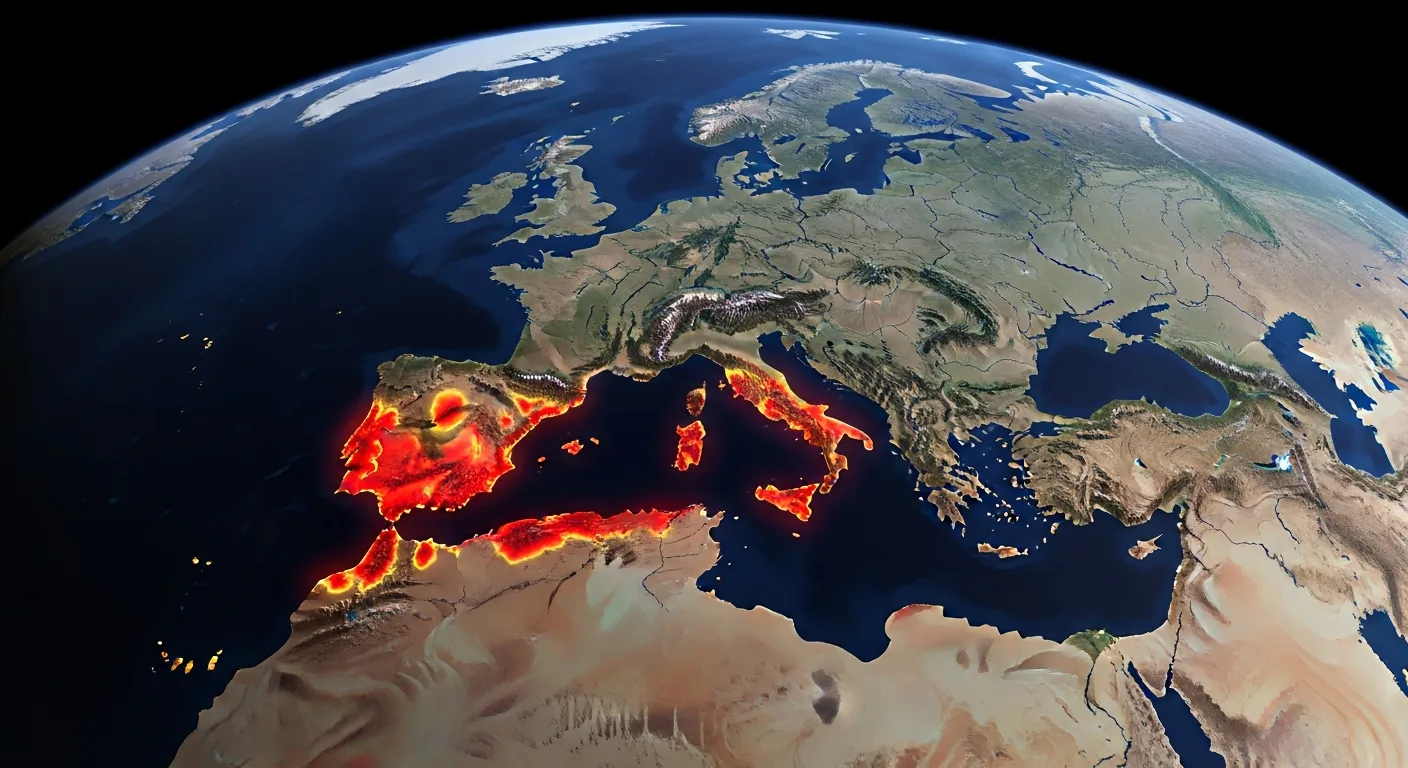
Through our Climate API, we provide site-specific environmental and climate data for Europe, including heat, storms, flooding, wildfire and environmental noise. This is where the bridge to health lies: the same data can also be used to check hospitals and care homes for heat stress and extreme weather.
Why energy and health sites face similar questions
At first glance, a solar park and a hospital have little in common. For both, however, the site is fixed, and the weather at the site affects how well they do their job. In its first European Climate Risk Assessment in 2024, the European Environment Agency identified 36 climate risks. In the agency's assessment, they threaten, among other things, energy and food security, infrastructure, financial stability and people's health.
Heat is a good example. For solar modules, output falls as module temperature rises. Our model chain takes this into account as temperature-related derating. For battery storage and transformers, heat is also one of the risks in the risk and measures register. In a care home, the issue is not kilowatt hours but the strain on residents and staff. The data basis is nevertheless similar: how often do hot days occur at the site, and how does that frequency shift in the climate scenarios?
The same applies to flooding and extreme weather. A substation and a hospital both depend on access, electricity and safe operation. Anyone who knows early which hazards are relevant at a site can plan measures before an event occurs. Earth observation, weather and climate data answer this question when they are prepared for the individual site.
What the listing means and what it does not
The listing in the member directory is an entry in a network. It is not a funding commitment, not a certification and not an assessment of our models by the German Space Agency. It means that we are part of a group in which companies and research institutions from space and health exchange ideas, initiate development projects and open up new applications.
For our customers in the energy sector, nothing changes in the methodology. The platform continues to calculate with the same weather and climate data, and the limits remain the same: our results are a first assessment. They are not a certified yield assessment, not grid operator data and not financial or investment advice.
What comes next
In the network, we want to do two things above all. First, we want to discuss with healthcare institutions and companies which site questions they have about heat and extreme weather, and which data they really need for them. Second, we want to learn from other members, for example in handling large amounts of data and validating models. Both are topics that Space2Health explicitly addresses.
Are you a Space2Health member, or do you look after healthcare sites? Then please get in touch if you have a question about heat, flooding or extreme weather at your site. Our focus remains wind and solar parks. If you operate a park, we will show you in a call what weather and climate mean for your site.
Sources and historical context
All information on INNOspace, the networks and Space2Health reflects the sources as of 21 October 2026. Figures on the INNOspace Masters competition, the exhibition and the networks come from the German Space Agency at DLR, not from our own research.
- German Space Agency at DLR: Innovation und Neue Märkte (INNOspace, INNOspace Masters, networks, INNOspaceEXPO, ESA programme "Business Applications and Space Solutions")
- Space2Health: INNOspace network for space and health (initiative, topic areas, network composition)
- Space2Health: member directory
- Space2Health: EnviroTrust UG profile
- European Environment Agency: European Climate Risk Assessment (EUCRA), 2024
Discuss your asset with us
30 minutes, online. Send us a park, a MaStR registry number or an asset list in advance. We show you your own asset with yield, climate shift and risks. Then you decide whether a pilot makes sense.